
This is the fourth installment in our “Days of Wine and Music” series. We will begin by discussing the Greek contribution to opera and then zero in on a couple of important Greek varietals. Even a cursory look at the wine map that we uploaded last week will inform the reader of the large number of varietals indigenous to Greece, so our presentation of just two of them hardly scratches the surface of the vast and variegated vineyard that is Greece.
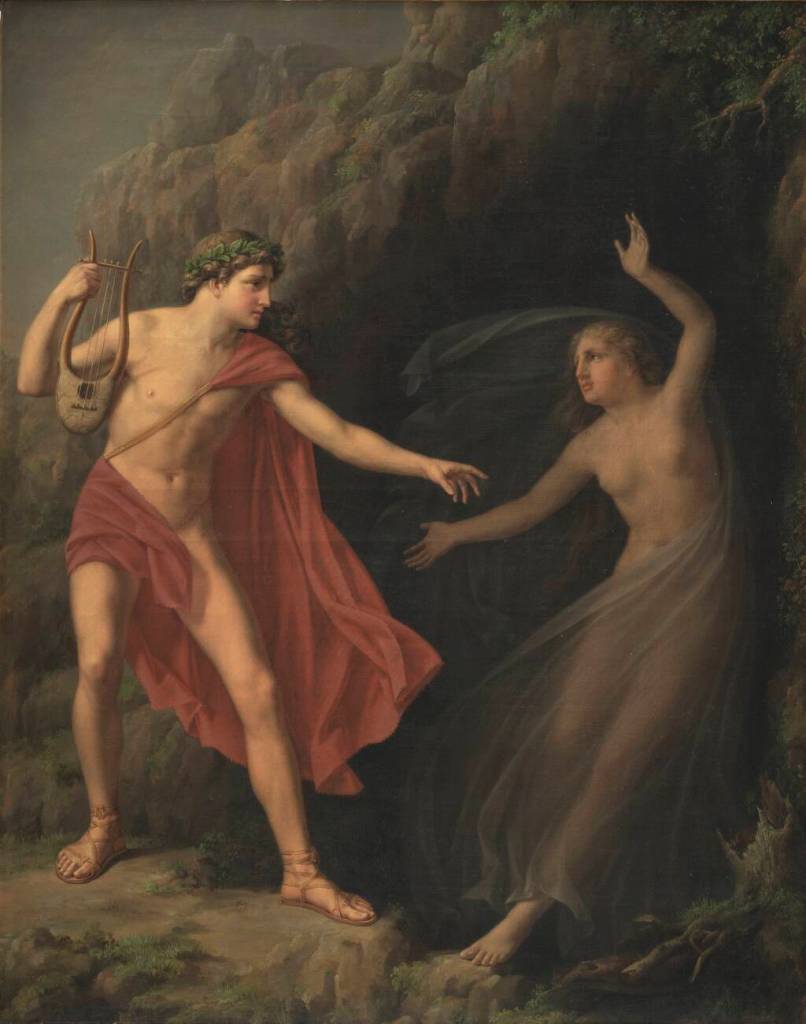
Every opera tells a story, of course, and it is the librettist’s responsibility to find a good one. In these days of seemingly endless copyright protection, writers, of course, must exercise caution, lest they step on the paws of Mickey Murine or offend other such protected creatures. Not so with mythology, though. There, it is public-domain territory, and those who wield the pen or tap out works of fiction on teeny-weeny screens are free to roam those fertile plains, take what suits their needs and fancy, and employ or adapt them as they see fit. And let’s face it, when it comes to mythology, the Greeks have it bigtime! This fact was obviously crystal clear to the young Angelo Ambrogini di Montepulciano (sounds like a wine, doesn’t it?), a.k.a., Politian, who used the story of Orpheus and Eurydice, albeit via Ovid, to create what M. Owen Lee has identified as “Europe’s first secular drama sung in a modern language” [i.e., Italian]1, or at least the first one that we know of.
The two varietal wines we have chosen to look at this week are Assyrtiko, a white grape, and Xinomavro, a black one. Assyrtiko, which is one of our favorites here at Drinking Japan, is a grape for all styles, a bit like Riesling in that sense but sans that variety’s low alcohol level. It has high acidity and high alcohol, making wines made therefrom both suitable for aging and an appropriate companion to many Greek dishes, which typically include olive oil. Depending on the style of wine produced, it can be flinty with citrus notes, opulently sweet, or have pronounced secondary notes due oak aging.
Xinomavro is Greece’s answer to Italy’s Nebbiolo, or is Nebbiolo Italy’s answer to Greece’s Xinomavro? You figure that one out as you wait for it to age in bottle. This is a grape that produces a wine whose tannins and acidity can be found somewhere in the stratosphere. If you have the patience to wait for them to come down, you will be rewarded.
1Lee, Owen M. “The Birth of Opera from the Spirit of Orpheus,” A Season of Opera (Toronto: University of Toronto Press, 2000).
* Orpheus and Eurydice by Goos, Carl – 1826 – National Gallery of Denmark, Denmark – CC0.

 Drinking Japan