This week’s entry is another Intermission in our lengthy Days of Wine and Music series.
If you are the type of person who scrapes the caviar off the cracker and eats the roe, who cuts the decorative buttercream flower from the center of the birthday cake and consumes it whole, or drinks the rum and discards the Coke, you should love some of Shiino’s wonderful garnishes. You will want to make them the main event, not the gastronomical adjunct.
With a history dating back to 1894, this Kanagawa Prefecture based firm offers a wide array of products, with a special focus on shuto, which is a kanji wordplay of sorts and beyond the purview of this review. Suffice it to say, that shuto, as defined in their promotional literature, is “made by salting and aging rare parts of tuna and bonito over a long period of time.”
Before presenting our sensory evaluations of the products that we sampled, a few general comments are in order. Many overseas diners are now familiar with the basics of washoku—miso and dashi—and the gastronomic equivalent of celebrities—sushi and tempura—so it is high time to introduce them to some of the delicacies that might appear on dining-room tables here. Let’s go.
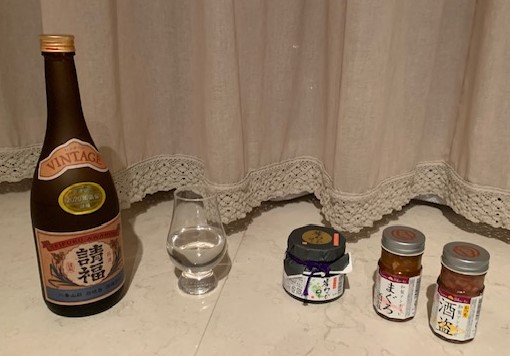
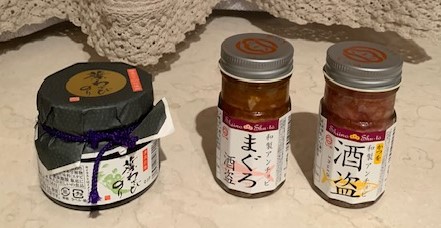

We tasted four Shiino products: Maguro Shuto (Tuna Shuto) , Katsuo Shuto (Bonito Shuto) and Hawasabi Nori (a seaweed-wasabi garnish/spread prepared in the tsukudani style). These items are pictured above, along with our beverage of choice for this tasting, Vintage Seifuku Awamori (請福), another JFEX Gem and next week’s featured entry. The fourth product is reviewed in the penultimate paragraph. The tasters in this case were three people, all of whom are thoroughly familiar with and appreciative of Japanese cuisine.
Both the tuna and the bonito were complex and savory, with the former being a little less salty. Both seemed like excellent gateway products for those unfamiliar with shiokara, which Shiino also produces. They both went very well with the tofu pictured above, as did the wasabi-seaweed spread, although that is obviously intended to be eaten with rice, which will prove to be a much better pairing. Consumers will find that all of these products can serve as tasty accompaniments to many dishes. Be creative and you will be rewarded.

Finally, we sampled these cute little crimson-colored anthropomorphic pickled gourds, which the company recommends for weddings and “New Year’s as a good luck pickle.” We consumed these along with eel prepared in the traditional Japanese style. We also decided to nibble on some Nara Zuke, which is often served with eel, and another pickle, Nozawa Zuke. The last-mentioned does not go especially well with eel. Nara Zuke has a well-documented track record with unagi and is always a pleasure. The little red guys proved to be up to the job. The saltiness was balanced by a certain fruitiness, and the latter was well suited for the sweet and oily eel.

Shiino also has something called “Kamakura Squirrel,” which is not what you think. Keep your pants on, okay?
Shiino Foods Co., Ltd: https://en.shiino.co.jp

 Drinking Japan