This week and next week we will focus on a significant international development in the world of sake.
“Intangible cultural heritage includes the practices, knowledge, and expressions that communities recognize as part of their cultural identity, along with associated objects and spaces.”
The above citation is from UNESCO’s website. UNESCO is the organization whose purview includes World Heritage—natural, manmade and touchable, and human-generated but intangible. The paragraph from which the quote was taken goes on to state the following: “Transmitted through generations, this heritage adapts over time, reinforcing identity and respect for cultural diversity.” Aside from the seemingly obligatory “diversity” and the implication that that is always a positive (those readers old enough to remember the Betamax might immediately grasp our point), this is a noteworthy quote. If we may summarize what is going on here, the designation is a snapshot that will serve as a permanent record of Japanese knowledge and ingenuity vis-á-vis sake production and the use of that venerable “magic powder” affectionately known as koji mold. This “photograph” can readily serve as a proof of authenticity. However, the quotation also acknowledges the “you-can’t-step-into-the-same-river-twice” nature of existence. Evolution is inevitable and may result in a better product or a worse one, as the case may be, but it WILL NOT BE AN AUTHENTIC ONE.
Congratulations to all those sake brewers, workers, merchants, and innovators in the distant past who bequeathed us this nectar, and we’re not using nectar in the “bug-juice” sense of the word. Understand?
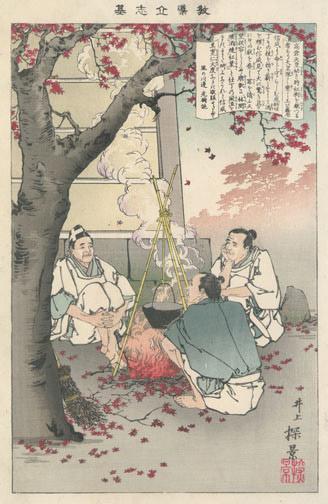
- A woodblock by Inoue Yasuji, which we would like to retitle Our Kind of Picnic.

 Drinking Japan