When the expression “hill of beans” is used to refer to something, it means that the referent is so common that it is insignificant and worthless. In reality, however, nothing could be further from the truth, especially if the beans are natto. As many non-Japanese now know, natto is fermented soy beans. Viscous and pungent, they pack a punch on the palate and in the gut, as well. When the microorganisms contained therein (the healthful ones) enter the intestines, they meet up with the bad ones. The more of the good ones there are down below, the better it is for us. We like to think that a microscopic Saint Valentine’s Day Massacre is taking place on those occasions, or at least a reenactment of Gunfight at the O.K. Corral. To be a tad more scientific about this, we will quote from a news release by Stanford University: “A diet rich in fermented foods enhances the diversity of gut microbes and decreases molecular signs of inflammation, according to researchers at the Stanford School of Medicine.”1


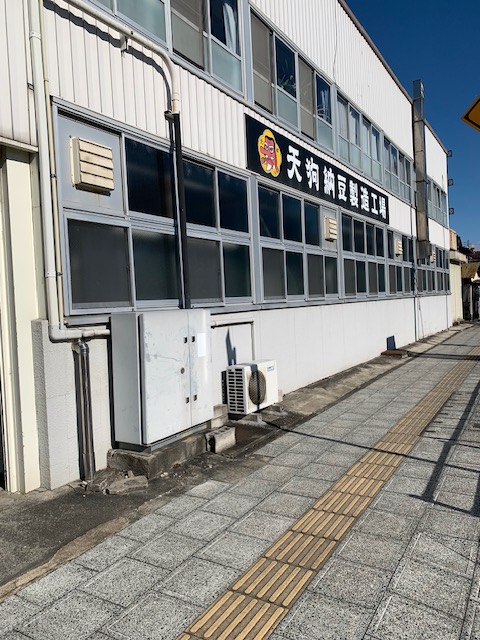
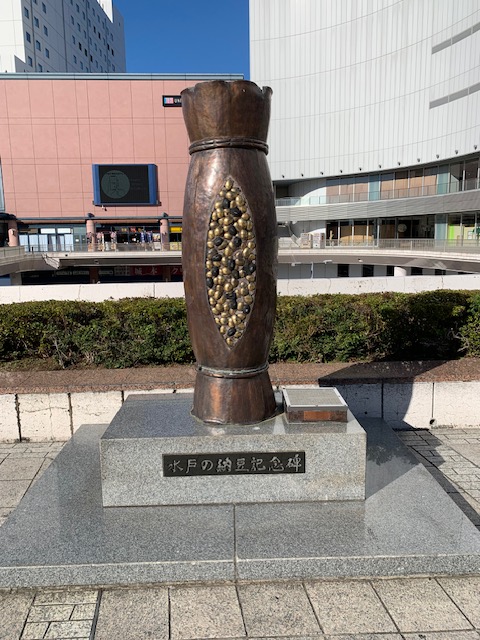
All that is well and good, but the primary reason we eat natto is because we love it. Therefore, it is not surprising that we traveled to the unofficial natto capital of the world, Ibaraki’s Mito City, for some of the real deal. We made our obeisance at the natto sculpture outside the station and later headed to Tengu, a major manufacturer, where we bagged more than a few packets of the stuff at their retail outlet and took a few pictures to boot.

To those unfortunate readers who have not tasted natto, there are several ways that it can be consumed. Various things like condiments (mustard and soy sauce, for instance) and vegetables (okra is a popular one) are often mixed into it. Speaking of which, it is essential to mix it thoroughly, until it is stringy and frothy and fully capable of doing battle with those bad guys down below.
1Weaver, J., “Fermented-food diet increases microbiome diversity, decreases inflammatory proteins, study finds,” https://med.stanford.edu/news/all-news/2021/07/fermented-food-diet-increases-microbiome-diversity-lowers-inflammation (July 12, 2021).
Tengu: http://www.tengunatto.jp/

 Drinking Japan