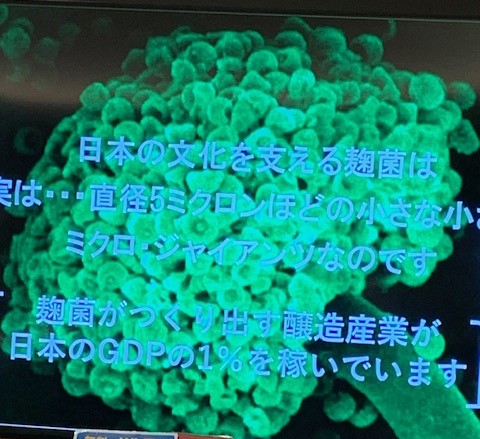
The title of this entry is taken from American poet Edna St. Vincent Millay’s “Still Will I Harvest Beauty Where It Grows.” The subtitle is a reference to our presence at a lecture by Dr. Hiroshi Konno, which was delivered at the Japan Sake and Shochu Information Center (JSS) in February of this year.
Millay’s poem specifically references fungus:
Still will I harvest beauty where it grows:
In coloured fungus and the spotted fog
Surprised on foods forgotten….
Yes, there is beauty on the fringe, be it slimy frogs or creaking doors (read the poem for yourself), but in this beauty contest of the outer limits, fungus occupies a special place, and that is particularly true for Japan’s national fungus–Aspergillus oryzae and its “cousins,” A. kawachii, and A. luchuensis, collectively known as “koji mold.” Without this marvelous mold we would not have sake, miso, mirin, shochu, and awamori.
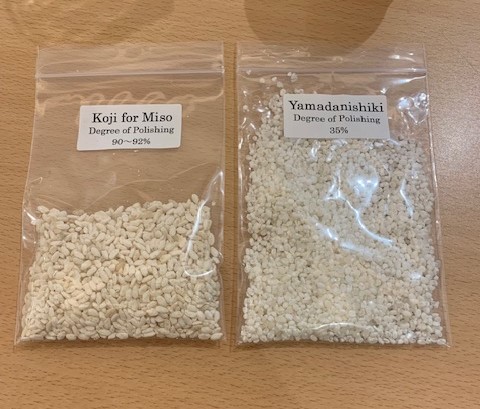
Dr. Konno is a microbiologist, whose company, Konno Shoten Co., Ltd., supplies koji mold spores to Japan’s brewers. His lecture was chock full of information, to be sure, and we came away with the impression that this fungus is beautiful, healthful, and not an insignificant player in the nation’s economy.
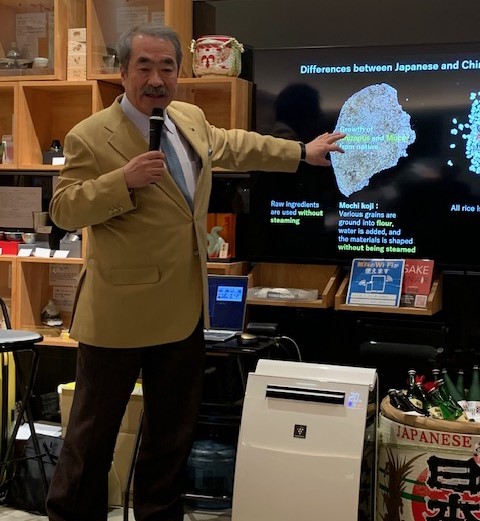
We took the opportunity to ask Dr. Konno whether the practice of using koji mold for the faux-dry aging of steak, which seems to be popular in some quarters, might pose any safety issues. Real dry aging takes a first-rate steakhouse over a month to achieve but can be completed by the fakers in about two days. Dr. Konno advised us not to engage in this practice. And we thank him for that and for his wonderful lecture.
https://www.poetryfoundation.org/poems/148565/still-will-i-harvest-beauty-where-it-grows

 Drinking Japan