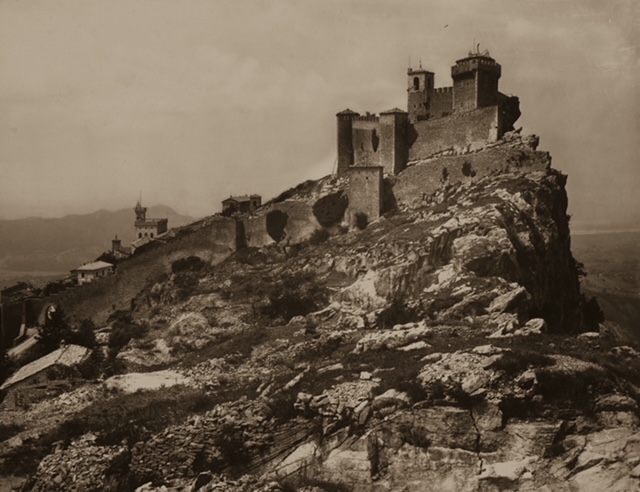
This is the eighth entry in our Days of Wine and Music series. For the next few weeks, we will turn our attention to a country that, owing to its size, is nearly invisible on world maps and encounter a winemaker-musician who is producing some fine wines from local grapes, as well as from international varieties.
No doubt some of our well-educated readers will have read Small Is Beautiful: A Study of Economics As If People Mattered by E.F. Schumacher. Schumacher’s 1973 book has had a significant impact on a number of generations and has gone through numerous printings. For those who have not read it, it might prove to be a worthwhile read. Have a look at it.
Schumacher’s title, which has achieved catchphrase status over the past half century, expresses a sentiment that is far more widespread today than it was in 1973. Who wants the cavernous mansion with a plethora of unused rooms, the gas-guzzling thirsty beast with tailfins, or that luxury watch that weighs nearly as much as it costs, if the price were paid in gold? Nobody, right? Well, okay, maybe some Hollywood types.
Our title this week is slightly ambiguous and therefore requires some clarification. In this case, the largeness of the fish is good, and the smallness of the pond is good, too. It is the smallness of the “pond” that we want to address here.
Schumacher’s teacher was Leopold Kohr, an academic who made some very important observations regarding the attractiveness of small geopolitical entities. In a nutshell, if peace is what you seek, go small, or perhaps “tiny” is the better word. Reproof against embracing its polar opposite is cogently stated by Professor Henry C. Simons: “War is a collectivizing process, and large-scale collectivism is inherently warlike. If not militarist by national tradition, highly centralized states must become so by the very necessity of sustaining at home an inordinate, ‘unnatural’ power concentration, by the threat of their governmental mobilization as felt by other nations, and by their almost inevitable transformation of commercial intercourse into organized economic warfare among great economic-political blocs. There can be no real peace or solid world order in a world of a few great, centralized powers.”1
Tiny states are not preoccupied with boogeymen, real or conjured up hoodoo-style, meant to manipulate the populace into acquiescing to ill-advised policies. Citizens of microstates, at least those in Europe, are likely to be NIMBY (Not in My Backyard) in the extreme, as the country is, after all, practically their backyard, and should their government contemplate doing something untoward by adopting a policy that might put their nation and their lives in jeopardy, they will be better positioned to express their discontent directly to government officials. Considering all of this, perhaps it is time for a slightly altered version of that classic chant from 1969: “All we are saying is give us less land. All we are saying is give us less land….”
Next week we visit the Republic of San Marino.
Opening picture credit: San Marino by Unknown – Promoter Digital Gallery, Italy – CC BY-NC.
https://www.europeana.eu/item/2024919/https___digitalgallery_promoter_it_files_original_c2901b044e495ea8d91755fbad8ed9ba_jpg
1Kohr, L. The Breakdown of Nations (Cambridge: Green Books, 2001).

 Drinking Japan